NowHabit
Notes from Now Habit by Neil A. Fiore, Ph.D.
Creating Safety: The First Major Step Out of Procrastination" (Excellent Analogy)
- walking along a 30-foot board (task)
- board is suspended between two buildings, 100 feet above the ground (task determines your worth)
- you are frozen until you realize the building you are on is on fire (perfectionism/procrastination raise the stakes & time pressure forces you to act)
- board 100 feet above the ground with a safety net (indisputable sense of worth acts as a safety net)
Five Self-Statements that Distinguish Procrastinators from Producers
- I have to.
- replace w/I choose to.
- I must finish.
- replace w/When can I start?
- This is so big.
- replace w/I can take one small step.
- I must be perfect.
- I can be human.
- I don't have time to play.
- I must take time to play.
Combined: I choose to start one small imperfect step knowing I am human and I must take time to play.
Use Pull-Method Motivation
| push method | pull method |
| peel the potatoes or you'll lose your weekend pass | earn another day of leave for each basket |
| increase the number of clients called per day or find another job | learn how to communicate effectively with clients and you'll be able to see more clients |
| read this entire shelf of books by the end of the semester | imagine that, as you read a chapter, you are placing it on this empty shelf |
Tools
- three-dimensional thinking
- consider any of the places to start, don't limit yourself to one right place
- permit yourself time along the way to learn, build confidence, and ask for help
- don't be critical that you're only starting when you "should be finished."
- reverse calendar
- think backwords from the goal & deadline to the present
- work of worrying (don't stop with just worrying, develop an action plan)
- What is the worst that could happen?
- What would I do if the worst really happened?
- How would I lessen the pain and get on with as much happiness as possible if the worse did occur?
- What alternatives would I have?
- What can I do now to lessen the probability of this dreaded event occuring?
- Is there anything I can do now to increase my chances of achieving my goal?
- persistent starting
The Unschedule
- Do not work more than twenty hours a week on this project.
- Do not work more than five hours a day on this project.
- You must exercise, play, dance at least one hour a day.
- You must take at least one day a week off from any work.
- Aim for only thirty minutes of quality work.
- Work for an imperfect, perfectly human first effort.
- Start small.
- Schedule only
- previously committed time such as meals, sleep, meetings
- free time, recreation, leisure reading
- socializing
- health activites such as swimming, running, tennis
- routine structured events such as commuting time, classes, medical appointments
- fill unschedule with work on projects only after you have completed at least one-half hour
- take credit only for periods of work that represent at least thirty minutes of uninterrupted work
- reward yourself with a break or a change to a more enjoyable task after each period worked
- keep track of the number of quality hours worked each day and each week
- always leave at least one full day a week for recreation and any necessary small chores
- before deciding to play, take time out for just thirty minutes of work on your project
- focus on starting
- think small
- keep starting
- never end down
Managing People Who Procrastinate Commitment to a task sparks much more creativity and motivation than compliance.
| Compliance | Commitment |
| You'd better finish by noon. | What can you get me by noon? |
| You have to get here on time, or else. | I've placed you in a responsible position and I'm depending on you to be here at nine o'clock. |
| Do it exactly as I showed you. | We need to be able to trust each other's work, so I need you to follow the guidelines precisely. Let me know if you have any problems with them. |
Focus On Starting vs. Finishing
"Who Has the Thickest Face and the Blackest Heart?"
by Matt Furey
Note: The following is an article that was first published in 1996 for W.I.N. magazine. In 2001, a revision of this article was featured in GRAPPLING. On a regular basis, readers who lost this article asked if I could republish it. Well, here is yet another revision. Enjoy!
How about a prediction that I am willing to guarantee? A prediction that is timeless and true? A prediction that will repeat itself every single year, at every single combat sports event in the world? In fact, how about I guarantee that this prediction will repeat itself in EVERY arena known to man?
Here it is: In all arenas, the person who WINS will be the one with the thickest face and the blackest heart.
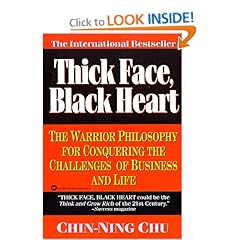
Thick face-black heart is a term coined in the 1911 book, Thick Black Theory. Written in China, Thick Black Theory was banned the day it was published - and still is. What does this mean? It means that there must be a message inside the book that gives POWER to people - and those in power don't want them to have it. In a nutshell, it must be one amazing book.
Thick Black Theory has never been translated into English, but the essence of it was summarized in Chin-Ning Chu's book, Thick Face, Black Heart. Let me paraphrase some of the particulars:
Thick Face: The quality of being immune to the criticisms or negative opinions of others. The ability to set aside your own doubts and fears, and proceed as if victory is inevitable.
Early on in any highly successful person's career, whether the person is a combat athlete, a business exec or a politician, he will endure criticism from others. Some people will criticize the art he competes in; others his dedication; others the choice of career or his ideas, whether they are radical or mainstream. Of course, some will even question the successful person's abilities, skills and intellect.
I don't know of a single "success" who never had a moment of self-doubt or fear. Moreover, I don't know of any who did not have detractors. It1s the nature of the game. In fact, the more successful a person becomes, the more detractors he will have.
Truth is, many of the greatest champion athletes have become great because they feared losing. This fear drove them to train harder than anyone else - so when it was time to take center stage - they were ready. In business, many great decisions are made only when you mix a "burning desire to succeed" with a heavy dose of caution.
A thick-faced person isn't crushed by others1 criticism. Although, like anyone else, a successful person likes approval ... he doesn't need it to survive. I am fond of saying, "Eagles don1t fly in flocks. They fly alone." You cannot rise high in life if you depend upon the approval of everyone. You CAN however rise as high as you want or need with the approval of the right people.
What separates the champion or the "success" from the pack is the willingness to run on his own gas. If you believe in him and his dreams, fine. If not - his dream is more important than your opinion.
A thick-faced person does not lose sleep over another person's negative comments. Criticism bounces off his face and goes elsewhere; looking for a thin-skinned person to slap around.
A thick-faced person is undeterred in the face of defeat. He does not let "inner battles" absorb his energy. If he is nervous or fearful, he channels this energy into productive power by focusing on a vision. In short, when negativity comes from the outside, it bounces off; if it comes from within, it is trapped, gagged and suffocated.
Black Heart: The quality of being passionately committed to the actions you must take to achieve a goal - while simultaneously showing no compassion or concern for how others are affected by those actions.
A combat athlete with a black heart is a ruthless person. He may think highly of his opponent, but when the referee starts the bout, he is a competitive animal. He does not care how much his opponent wants to win. He does not care if his opponent cries when he loses. He does not care if his opponent has worked for many years to achieve the same goal. He wants to win more than anyone else - and he is going to win as impressively as he can ... and if his opponent is physically or emotionally crushed afterward, tough luck.
When I tell people about the importance of having a thick face and black heart, I occasionally hear comments like, "I disagree. You don't have to be mean in order to win."
"It's not about being mean, although it could be," I answer. "Truth is, one of the meanest things you can do is whoop someone with a smile on your face; to destroy someone with kindness."
Thick face, black heart can be used for good or for evil. Naturally, I believe it is better for society when a person uses the principles of Thick Face, Black Heart for good purposes. But never lose sight of the fact that this is a quality that is used by saints as well as sociopaths.
All champion fighters have a thick face and a black heart. And so do all successful people.
In boxing we have Roy Jones, Jr. Do you think he feels a bit of remorse when he brutalizes one opponent after another? Not a chance.
In the NFL we have the Tampa Bay Bucanneers and their totally focused head coach, John Gruden. Tell me, do you really think Gruden cares one lick about the feelings of the team he beats? No way.
In the forthcoming recall election in California we are about to witness mud-slinging at its finest. It may end up being the most ruthless campaign our country has ever seen, especially with Larry Flint and Arnold Schwarzenegger in the race. Sit back and watch the show.
Just remember, when all is said and done, the person who emerges as Governor will be the same type of person who emerges as champion in an athletic event. The winner will be the person with the thickest face and blackest heart.
[Matt Furey is a world champion martial artist and national champion wrestler who is also the best-selling author of Combat Conditioning. Be sure to get yourself a copy.]
'Learned Optimism' by Martin E. P. Seligman
notes by J. Zimmerman
J. Zimmerman on
Learned Optimism by Martin E. P. Seligman.
Seligman's Learned Optimism has become so important in the self-help field because it justifies its claims through its scientific foundation. The book is not only about optimism. It also validates the possibility of personal change through one's efforts and will.
Seligman on Explanatory Style
Seligman observes that there are three enormous differences in the Explanatory Style (the way in which a person tends to explain situations to herself) between pessimistic people and optimistic people:
- Temporary versus Permanent: how long something lasts and how frequently it occurs.
"People who give up easily believe the causes of the bad events that happen to them are permanent: The bad events will persist, [and] will always be there to affect their lives."
"The permanence dimension determines how long a person gives up for. 'Permanent' explanations of bad events produce long-lasting helplessness and 'temporary' explanations produce resilience."
"Optimistic people explain good events to themselves in terms of permanent causes: traits, abilities, always's. Pessimists name transient causes: moods, effects, sometimes's." |
- Pervasiveness, which concerns how widespread something is:
| When something wanted ... | When something unwanted ... |
| ... happens to an optimist | Success is attributed to a universal explanation such as a widespread skill (e.g. 'I am smart'). | Failure is attributed to a specific explanation (e.g. 'Professor Seligman is not fair'). |
| ... happens to a pessimist | Success is attributed to a specific instance (e.g. 'I am smart at memorizing phone numbers'.) | Failure is attributed to a universal explanation or generalization (e.g., 'All teachers are unfair'). |
- Personalization: Internal versus External attribution: Is it about you or about other people?
| "When bad things happen, we can blame ourselves (internalize) or we can blame other people or circumstances (externalize). People who blame themselves when they fail have low self-esteem as a consequence. They think they are worthless, talentless, and unlovable. People who blame external events do not lose self-esteem when bad events strike. On the whole, they like themselves a lot better than people that blame themselves do. " |
Seligman says that you can use a different, more optimistic, way of explaining setbacks to yourself, and that this can protect you from allowing a crisis to drop you into depression.
Seligman found that people who give up easily have not argued against their negative interpretation of failure and their self-disparagement.
Those who avoid being snared by depression tend to listen to their internal dialogue, and then argue with themselves against their self-limiting thoughts, and quickly find more positive thought about the event that concerns them.
How can you figure out your style?
Seligman includes a series of tests that you can take, so that you can measure your explanatory style, and determine how you use those three dimensions (permanence, pervasiveness, and personalization).
How can you change your style?
The final third of Seligman's book is Changing: From Pessimism to Optimism. Using techniques of cognitive therapy developed by Steven Hollon and Arthur Freeman, he asks the reader to identify the ABC's:
- Adversity that is encountered.
- Beliefs that arise - what you think.
- Consequences - what you do.
Initially you simply record what happens.
Then he teaches you two techniques:
| "There are two general ways for you to deal with your pessimistic beliefs once you are aware of them. The first is simply to distract yourself when they occur - try to think of something else. The second is to dispute them. Disputing is more effective in the long run, because successfully disputed beliefs are less likely to recur when the same situation presents itself again." |
Who is Martin Seligman? A brief bio
Martin Seligman is a cognitive psychologist. He asks "What makes a person keep going after the death of a spouse or a child, or pick themselves up after their company folds."
He is credited with developing the learned helplessness theory of depression, and with discovering ways that people can become more optimistic and therefore less likely to succumb to depression.
Martin Seligman grew up in Albany, New York. As an undergraduate at Princeton, he majored in modern philosophy. Shifting to psychology, he became licensed as a psychologist in 1973, and then directed the clinical training program of the University of Pennsylvania psychology department.
Seligman has written over a dozen books and almost 200 articles.
We highly recommend Learned Optimism by Martin E. P. Seligman.
 [Thanks for visiting.]
Copyright
Malcolm Gladwell’s new book: The Outliers
Gladwell’s new book, *The Outliers* (2008) focuses on success and the hard work, social context and cultural background that explains why some people excel and others don’t. He has a related article in The New Yorker on genius (trivia note: a related post of his on this topic was rejected a long time ago by the New Yorker). Gladwell’s new book seems better at explaining the success of some than in its prescriptions for how to get others to succeed.

While The Tipping Point seemed to focus more on individuals and their power to change society, The Outliers focuses more on the social and cultural context of individuals to explain their extraordinary success. As per vintage Gladwell, it takes a very eclectic path toward its subject, looking at everything from a genius who lives on a horse farm in Northern Missouri, to why Canadians are better hockey players (and which Canadians are the best), to why Korean pilots are more likely to crash planes.
In a nutshell, Gladwell believes The Beatles’ success was due to the fact that in their early years in Hamburg, Germany, they had to play very long sets at clubs, in a wide variety of styles, which both helped them to get in their 10,000 hours (see below on its importance) and forced them to be creative and excel at experimenting. He notes the eerie correlation between who is a good pilot and what culture they came from. He explores why a little town in Eastern Pennsylvania has had zero heart attacks. He divulges that one 9 year stretch has accounted for more Outliers than any other. He credits the success of Chinese math geniuses to the their harder studies and greater patience in problem-solving, stemming from a cultural legacy of long days of work in rice paddies; Gladwell contrasts the Chinese proverb ‘No one who can rise before dawn 360 days a year fails to make his family rich’ with the American agricultural practice of letting fields lie fallow in winter, which led to a school year with summer vacations — a practice that works for children of the well-educated but fails children of the less-educated who give up many of their school-year academic gains over the summer. He credits Bill Gates’ success to early and sustained access to high-end computers. As Edward Tenner notes on Slate: “Memo to overscheduling, hovering, upper-middle-class mothers and fathers: Keep up the good work.”
Gladwell gave a related talk at the New Yorker’s conference last year called “Genius: 2012″. In the talk Gladwell explains how success in the 21st century is less about sheer intelligence and more about collaboration and hard work to get to the level of mastery in a topic (which he says typically takes 10,000 hours). Outliers describes how Bill Gates was able to get to 10,000 hours while still in middle and high school in Seattle due to 9 incredibly fortunate concurrences: among them, that his private school could fund a sophisticated computer in their computer club, and fact that he lived close to the U. of Washington, where he could use an even more sophisticated computer. Gladwell concedes that Gates is obviously brilliant, but still notes that many other brilliant youth never had the chance to become computer stars of Gates’ magnitude because they didn’t have access to these sophisticated computers.
In the New Yorker conference, Gladwell uses the contrast of Michael Ventris (who cracked the undecipherable code called Linear B of Minoans from Knossos on Crete) – and Andrew Wiles (a Mathematics Professor who solved what some thought might never be solved: Fermat’s Last Theorem).
Michael Ventris was the pre-modern genius: working mainly alone, in his free time, utterly brilliant and solving in a flash of insight after 1.5 years of free time during nights and weekends spent on the problem. Andrew Wiles, on the other hand, took about ten years to solve the theorem (close to those same 10,000 hours), and built on scholarly work over decades by a dozen other mathematicians. Gladwell notes that Wiles was less a pure genius and more a master at diligently working away at this problem, and building on the shoulders of other math giants. He also points to the important of hard work by showing that what separates better oncologists from worse oncologists was not intelligence or training, but how long they spent trying to find cancers from the colonoscopy results (*the mismatch problem*). [The mismatch was that oncologists often chosen for their brilliance and how fast they could examine the colonoscopies.] Gladwell notes that he thinks we need to think more about how to get a dozen Andrew Wiles than one Michael Ventris and thus we need to focus on *capitalization* (how some groups, like Chinese-Americans, are better able to translate given levels of IQ into managerial experience at 33% higher rates than White Americans.)
Speaking at a recent PopTech conference in Camden Maine in 2008, after explaining America’s abysmal capitalization rate, Gladwell’s gloom and doom gave way to optimism. “We have a scarcity of achievement in this country, not because we have a scarcity of talent. We have a scarcity of achievement because we’re squandering that talent. And that’s not bad news, that’s good news, because it says this scarcity is not something we have to live with. It’s something we can do something about.”
Gladwell: “Our romantic notion of the genius must be wrong. A scientific genius is not a person who does what no one else can do; he or she is someone who does what it takes many others to do. The genius is not a unique source of insight; he is merely an efficient source of insight.”
As advocates of the importance of social capital, it is obviously self-validating that Gladwell shows how social networks (beyond mere brilliance) is one of the factors Gladwell tags as a key to success. Scholars like Ronald Burt and others have clearly showed that lifetime earnings is more clearly a function of social interconnections than of levels of education.
There is interesting parallel work to Gladwell’s which shows up in work by an economist named David Galenson in an intriguing book called Old Masters and Young Geniuses.
Galenson believes that artists fall into two categories:
1) conceptual innovators who peak creatively early in life. They know what they want to accomplish and then set out with certainty to accomplish this. (Examples include Pablo Picasso, T.S. Eliot, F. Scott Fitzgerald, and Orson Wells).
2) experimental innovators who peak creatively later. They dabble, try new things (some of which succeed and some fail), learn from their mistakes, and make incremental improvements to their art until they’re capable of real masterpiece. Examples include Paul Cezanne, Frank Lloyd Wright, Mark Twain, and Jackson Pollock).
Galenson’s work parallels Gladwell’s in his belief that many “geniuses” are not born great but have the capacity to learn from others and learn from failures along the way. See interesting talk by Gladwell discussing Galenson in “Age Before Beauty.”
In a preview interview of Outliers in New York magazine, he talks about the case of Canadian hockey players:
Gladwell explains why the relative-age effect (a compounding of some initial advantage over time), explains why a disproportionate number of elite Canadian hockey players were born in the first half of the year (popularizing the research of a Canadian psychologist). Because Canada’s eligibility cutoff for junior hockey is January 1, Gladwell writes, “a boy who turns 10 on January 2, then, could be playing alongside someone who doesn’t turn 10 until the end of the year.” Since the differences in physical maturity are so great at that age, this initial advantage in when one starts playing competitive hockey helps explain which kid will make the league all-star team. And similarly, by making the all-star team earlier, the January 2 kid gets another leg up in more practice, better coaching, tougher competition, that compound that difference. Gladwell says it explains why by age 14, the January 2 birthday kid (who is only a couple days older than the December 30) kid is so much better at hockey. Gladwell says the solution is doubling the number of junior hockey leagues—some for kids born in the first half of the year, others for kids born in the second half. Or, as it applies to elementary schools, Gladwell believes that elementary and middle schools should put group students in three classes (January-April birthdays, May-August birthdays, and September-December birthdays) to “level the playing field.”
It’s interesting, as New York magazine points out, that at some level The Tipping Point was all about how one individual, taking advantage of connectors and influencers and the structure of social networks can move the world. The Outliers starts at the other pole and argues that people’s opportunity to move the world and excel, while partly driven by talent, is largely structured by opportunities provided externally. The Outliers is an invitation for governmental-policy to ensure that those who are talented can achieve, rather than be left to chance of who happens to be given the opportunities. While Gladwell is quick to seize upon the accumulated advantages of those who succeed, he overlooks the role of persistance and motivation (which someones arises out of adversity). Slate has a brief historical discussion of figures like Oppenheimer who overcame their disadvantages and quotes Sarkozy who said: “What made me who I am now is the sum of all the humiliations suffered during childhood.”
N.B.: Interestingly, Gladwell, who is a rare breed of journalist-celebrity, such that Fast Company once called him “a rock star, a spiritual leader, a stud”, insists that he is not an Outlier; he says “I’m just a journalist.” He does explain that he put in his own 10,000 hours at the Washington Post from 1987-1997, and it was only because of that investment in the craft of journalism that he could succeed when he moved to the New Yorker in 1997.
Read excerpts of Outliers here.
Related article “Genius: The Modern View” by David Brooks (NYT Op-Ed, 5/1/09).
The book, BTW, is panned by Michiko Kakutani of the NYT in “It’s True: Success Succeeds and Advantages Can Help” (11/17/08).
Interesting video of Gladwell presenting at AIGA’s Gain conference here; he discusses success via detailed story of Fleetwood Mac and shorter discussion of the Beatles. (PSFK)
Categories: 10000 hours · New York Magazine · PopTech · andrew wiles · bill gates · capitalization problem · collaboration · david galenson · hockey players · malcolm gladwell · michael ventris · michiko kakutani · mismatch problem · new york times · old masters and young geniuses · outliers
Tagged: andrew wiles, capitalization problem, malcolm gladwell, michael ventris, mismatch problem, outliers






 FAQ
FAQ Search
 Memberlist
 Usergroups
 Register


Yo sista, if my sons can only read one book tis the book the old man wants them to read
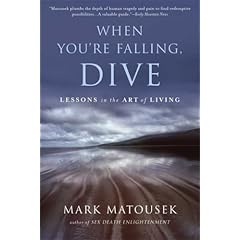
The When You're Falling, Dive: Lessons in the Art of Living (Paperback)
by Mark MatouseSome might liken these to "profiles in courage," yet I suspect that the people profiled would not lay claim to the word "courage." They are people who simply embrace the desire to choose. They are women and men who, with faith and hope, "dive" into the mystery of life and love.
While reading this book I wondered if I could live, will I live, as those profiled have chosen to live--tapping into the best and bravest of who they are.
The book cheers, confuses, and astonishes. It reminds us that the arbitrary and the seemingly senseless do not have to define who we are and who we will become.
If I could have only ten books in my library, this would be would one of them.